How we print
How screen printing works, from your artwork to a printed shirt, in four steps done by hand in our Orlando studio.
Screen printing is a craft of layers. Each color in your design gets its own screen, so we line every screen up on the same registration marks, and the colors land exactly where they should. For the history of the method, see screen printing.
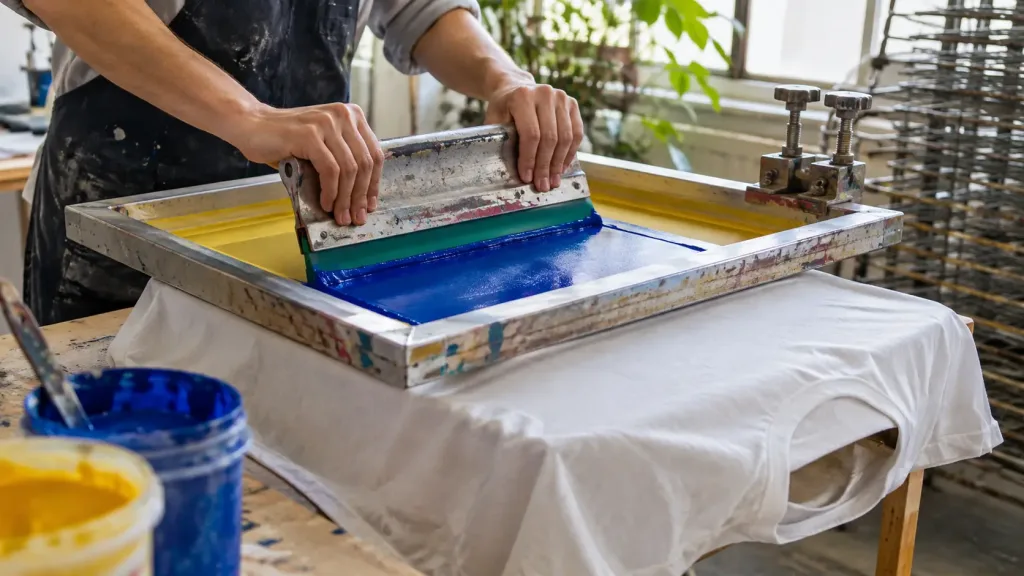
How screen printing works, in four steps
1. Separating the art
First, we split your artwork into one film per ink color. Then we send you a proof with the colors, size and placement on the garment, and we print nothing until you approve it.
2. Burning the screens
Next, we lay each film over a mesh screen coated in light-sensitive emulsion and expose it. Where the film blocks the light, the emulsion washes away, so an open stencil remains for the ink.
3. Mixing and pulling the ink
After that, we mix each ink to match your colors and check it under daylight. Then we lower the screen onto the garment and pull the ink through the mesh with a squeegee, one color after another.
4. Curing, checking and packing
Finally, every print rides through a heat dryer that cures the ink, so it lasts wash after wash. We check each piece, fold it and pack it in kraft.
Water-based or plastisol ink
- Water-based ink soaks into the fabric. Because of that, it feels soft and looks matte and lived in, so it suits light and natural garments.
- Plastisol ink sits on top of the fabric with crisp, opaque edges. That makes it the choice for dark garments and bold color.
Now you know how screen printing works at our bench. For the long version, with mesh counts and cure temperatures, read the screen printing process. Ready to start? Request a proof.